


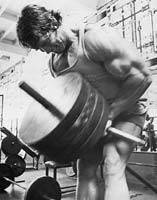
 Nothing is more impressive than being able to bang out 30 pull ups in a row or finishing a set of 10 with 90 lbs hanging from a belt. Nothing LOOKS more impressive than being able to hit an impressive front or rear lat spread with confidence. Furthermore, how many women do you know who can finish a set of 10 pull ups? Trust me, there aren’t many.
The reality is that we can accomplish all of these things with intense free weight back training.
Your back muscles comprise the second largest set of muscles, after the legs. Therefore, putting some serious effort into training your back will pay off huge dividends whether you are looking to burn a large number of calories, better fill out your shirts, condition your body for functional strength, or even to fix your posture from focusing too long on chest training.
Strong back muscles will allow you to:
- Pick up anything heavy off the floor or ground, working in unison with the legs.
- Burn nearly as many calories as you would when training legs.
- Move your body more easily through space, specifically when pulling yourself up.
- Protect yourself from muscle imbalances that occur from overtraining the chest.
- Row a boat faster than any of your punk friends.
Anatomy of the Back
For this discussion we are going to focus on the mid to upper back only. I won’t be talking at all about the lower back or glutes, as this is a discussion in and of its own. You can find out a bit more about lower back and glute training in the post about the top 5 best hamstring exercises. I will focus more on lower back in a separate article at a later date.
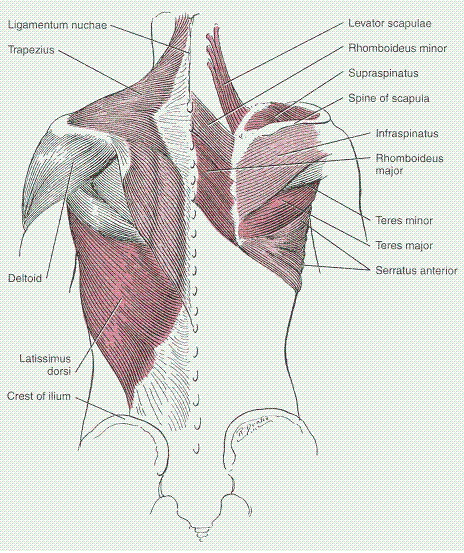
There are two main muscle groups that are visible even when our shirts are on. These are called the latissimus dorsi and the trapezius.
The latissimus, or lats, are the muscles that run from the armpits to the waist. This is what you see when people flex their backs as with a lat spread bodybuilding pose.
The trapezius, or traps, are the muscles that start in a point at the base of the skull, sit to either side of the neck, above the shoulders, and extend in a diamond shape to a point in the middle of the back. A muscle called the levator scapulae works in conjunction with the traps and lats.
Trap are what cause some big dudes to appear to have no neck. This is also how you can tell if someone is really serious about their training. Typically if someone has completely flat traps it means that they probably do not engage in significant free weight complex exercises like deadlifts, bent over barbell rows, cleans, and definitely not barbell shrugs.
The Smaller Muscles of the Back
Some of the smaller back muscles include teres major, teres minor, infraspinatus, supraspinatus, and rhomboideus (rhomboids). These are considered secondary muscles and are sufficiently stimulated when you train the larger latissimus dorsi with both vertical and horizontal movements.
The serratus is another back muscle that wraps around the body and it also visible from the font. If you desire to train the serratus directly, which many people do, the best exercise for that is probably dumbbell or barbell pull overs. In the past when I trained 4 days a week I often included pull overs on back day.
Functions of the Back
Contrary to what you might think when you picture a row, the function of the lats is to pull the arm down toward the pelvis. When the arm is in a fixed position such as with a pull up, the lats serve to bring the body up towards the arm. The function is the same, but the motion depends upon the position of the arms and torso.
Lats also function to stabilize the torso during many movements, including the flat bench press and overhead press.
Your traps function to facilitate scapular elevation (shrugging), scapular adduction (rowing) and scapular depression (pull downs). Often they work in conjunction with the lats and the other small muscles, especially when rowing or pulling down.
I have provided several instructional videos for the major exercises below. Provide your audience with more essential exercise demos by streaming live videos with desktop hosting from one of the best provider of cloud based solutions – Apps4Rent. Images and instructions are great, but seeing these exercises demonstrated by real people can make the difference between correct and incorrect form and execution.
Top 5 Best Back Exercises
Update: Deadlifts
Because I have received so many comments ripping me for not including deadlifts on this list, let the record show that I did indeed mention deadlifts right here at the top of the list, but decided not to include them in the list because they are already in the top 5 best hamstring exercises.
Deadlifts are probably the 3rd best back exercise after barbell rows and pull ups, so include them in your back workout as you see fit. Similarly, you could include good mornings in this list. To reduce the angst of hardcore weightlifters, I have revised this list to include deadlifts as the #5 best back exercise.
My original comments regarding deadlifts are as follows:
Of course deadlifts are part of this list, but I intend to target exercises that train the upper and mid back directly. For more information on deadlifts and other lower back exercises, see my post about the 5 best exercises for hamstrings.
- Barbell Bent Over Rows – Horizontal training
Bent over rows with a barbell is arguably the most important back exercise you can do for pulling strength and thickness in the upper body. This is a compound movement that works everything from traps to lats to lower back and hamstrings. Using proper form, bent over barbell rows will help you stand apart with thickness and strength, from the people who only do pull ups, chin ups, or (God forbid) pull downs.To set up: you should start by standing on a box or platform with the loaded barbell. This is necessary to avoid the plates hitting the floor when you use 45 lb plates. Your stance should be shoulder width for conventional barbell rows. Now, keeping your knees slightly bent, your head up, and your back straight, bend over until your upper body is lower than 45 degrees to the floor. My goal is always to get as close to parallel with the floor as possible.The weight should be hanging straight down from your arms at this point, directly below your chest. You should have a pronated grip on the bar; your palms should be facing towards you. Feel free to use a bit of chalk if you are rowing really heavy. NO STRAPS!
To row: to start a row, use your back muscles to pull the bar straight up to touch your chest. The elbows should be tucked in, head up, back straight, and you should NOT bounce. Lower the weight under control and repeat.
Variations: close grip, wide grip, medium grip, two arm dumbbell rows, supinated rows (palms facing away).There is also a machine called the T-Bar that can be used for rowing. Old school lifters might even put one end of an Olympic bar in the corner of a room, and use the other end as a T-bar and a neutral grip cable attachment as the handle.The following is the best video that I could find on YouTube for a demonstration of barbell bent over rows by someone who doesn’t look like a complete puss, although I don’t advocate putting the bar on the floor between reps:UPDATE: Since writing this article I have embraced barbell rows with a pause on the floor. I don’t recommend either variation over the other, but I do recommend trying them both. As with all exercises, you should probably use the variation that you hate most, but I don’t fault anyone for using the variation that they like most.
You should also watch this video just for fun: Bent Over Rows by Chrissy Zmijewski. She has some good points, but I believe in going deeper than 45 degrees with the upper body.
- Pull Ups and Chin Ups – Vertical training
Pull ups and chin ups are a true measure of strength. They are one of those exercises that can be used to gauge a person’s physical strength relative to their body weight. For example a powerlifter might be able to bench press 600 lbs at a body weight of 280 lbs, but maybe he can only do 4 pull ups. Meanwhile a 175 lb guy can only bench 315, but he can bust out about 30 pull ups.So let me ask you, who is really stronger? Better yet, which person’s strength would you wish to have? Sorry, but I’d rather be the smaller guy.To set up: stand on a box or a platform if you need to, or just jump up, so you can reach the bar. Pull ups are typically harder than chin ups, but I recommend you switch off between the two. Pull ups use a pronated grip (palms down, or in this case palms facing away), while chin ups use a supinated grip (palms up). Hands should be just wider than shoulder width for a medium grip pull up, or just inside shoulder width for a medium grip chin up.
To pull up: the goal is to pull yourself up until your chin is over the bar. Keep your head up, possibly looking at the ceiling, and get that chin over the bar, pause just long enough to get a full contraction. Lower yourself back down so that your arms are about 99% straight, don’t bounce.If you can’t do a pull up, most gyms have assisted pull up machines. Start there and work your weight towards your first bodyweight pull up.If you can do more than 10 pulls up with bodyweight, it might be time to consider weighted pull ups and weighted chin ups. You can do this by hanging a dumbbell between your legs or ankles, or by using a belt with a chain to suspend the weight between your legs.Variations: wide grip, medium grip, narrow grip, neutral grip (palms facing each other), pull ups, chin ups, towel pull ups to blast your grip and finger strength. Many people do lat pull downs on machines or with cables, but I’m telling you not to. Stick with free weights!Here is our friend Scott Herman to show us how to do an interesting variation – tennis ball pull ups.
- Barbell Shrugs – Upper back
Shrugs are specifically a traps only exercise. The lats don’t come into play at all. You can go pretty heavy on shrugs. I built a decent set of traps back in the day by working up to 10-12 reps with between 495 and 585 lbs on a standard Olympic bar.To set up: unless you feel like deadlifting the weight off the floor, your best bet is to unrack the bar at thigh height from a platform, squat rack, power rack, or whatever else you can use. This is one of maybe 2 exercises for which I condone using straps. You want to avoid using an alternating grip if possible, and sometimes using chalk just doesn’t cut it if you are using heavier weight than you typically deadlift.To shrug: take a pronated grip on the bar just outside your hips and unrack the weight so that it hangs to mid thigh. Always stand straight with your head up, and knees just barely bent. Try to touch your shoulders to your ears by shrugging straight up, as high as you can. Hold for half a second to really get that contraction. Lower the weight under control back to mid thigh.Variations: dumbbell shrugs are good too, but you can’t use as much weight.Here is a really controlled version of the wide grip barbell shrug. It’s good stuff. - One Arm Dumbbell Rows – Horizontal training
This is a great way for you to isolate each side of your back in turn. While you can’t go as heavy as barbell rows, you can still go pretty heavy and you can get a fuller contraction with a greater range of motion because the barbell does not restrict your scapula from fully retracting on each rep.To set up: grab a dumbbell and place it beside a bench. Now kneel with one leg on one end of the bench and place your hand on the other end for support. At this point your upper body should be parallel to the floor, and your free leg should be planted just behind you and to the side of your body for support.To row: grab the dumbbell with a neutral grip (palm facing your body), arm fully extended and lift the dumbbell off the floor. From this point you want to row the weight up and back, pulling your hand in just above your hip, and getting your elbow also up and back as far as possible. Experiment with wrist angles to make this exercise harder, easier, or more comfortable for you.Variations: you can use a machine or a cable exercise for this, but I highly recommend you stick with free weights. - Barbell DeadliftsDeadlifts belong in this list as well as in the top 5 best hamstring exercises, so here it is:Deadlifts are one of the primary, fundamental exercises for all serious weight training programs. Deadlifts work 100% of your legs and they require functional stability from 95% of the rest of the muscles on your body. Using proper form, deadlifts will help you get stronger, gain more muscle, and burn more calories than any other single exercise after the squat.To set up: the barbell rests on the floor, sitting just above the ankles right in front of the shins. Your stance should be shoulder width for conventional deadlifts. Bending your knees, reach down and grab the bar so that your knees are actually inside your elbows. When going heavy, it helps to alternate your grip where one hand is pronated (palm facing you) and the other hand is supinated (palm facing away).To deadlift: to start a deadlift, use your whole body to begin to lift the bar off the floor. Arms should be straight, knees should be bent. The object is to lift the weight with your legs, glutes, and hips, rather than with your lower back. In fact your lower back should not bend that much, should in fact be pretty straight, and should definitely NOT be rounded. You accomplish this by keeping your head up and by driving with your hips. It is of utmost importance to keep the bar close to your body during the lift.At the top you should stand up straight, but do not over extend your lower back as if you were doing some kind of hyper-extension. The driving force at the top should be more of a hip thrust than a lower back spasm. Lower the bar under control, keeping it close to your body.
Variations: close stance deads, wide stance deads, sumo style deads, deads off a box, rack pulls or pin pulls, deads or rack pulls with chains or bands.
Honorable mentions: pull overs, cleans, snatches, and…
Dumbbell Reverse Flyes
This exercise used to be listed at the #5 best back exercise, but I really couldn’t live with myself for including it in that list. Therefore, read this section while keeping in mind that dumbbell reverse flyes are probably somewhere in the top 10 best back exercises, but it is not top 5.
OK, you might be thinking this exercise is foo-foo, but it really works the smaller muscles in your upper back, including your rear delts. I guess I wouldn’t really recommend this as a staple exercise for powerlifters or other strength athletes, but it is mandatory for bodybuilders. This will really help to separate the muscles in the back, and will build the rear delts, which are typically very hard to cultivate.
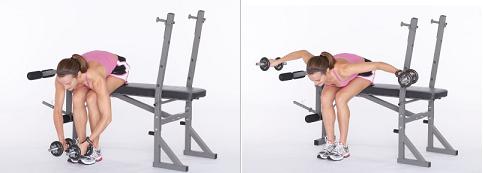
To set up: standing or sitting, grab some dumbbells, bend over so that your upper body is parallel to the floor. Allow the weights to hang at your sides, arms fully extended.
To reverse fly: keeping your back flat and straight, raise the weight vertically until your hands are at their highest possible position. Hold for half a second to contract. Lower the weight under control, but stop a couple inches short of where you started. The goal is not to pause at the bottom of the movement for rest. Tension should be kept on the muscles at all times.
Variations: because this is not a compound exercise, reverse flies on any number of machines or cables are usually an acceptable alternative to dumbbells.
 Reverse Flyes |
To use this exercise list optimally, you will want to choose 1 horizontal movement and 1 vertical movement, to work into each workout. For full body workouts, choose only one exercise each day, but be sure to alternate between horizontal and vertical. However if you are in a back specialization phase you can definitely choose 1 vertical and 1 horizontal movement for each workout to really force your back to adapt.
If you use the outdated method of splitting up your body parts each day, you can choose to split your back into horizontal and vertical training by using 2 horizontal exercises on horizontal back day, and 2 vertical exercises on vertical back day. Often horizontal back is paired with chest and vertical back is paired with legs.
Tags: back, back training, lats, traps, weight lifting, Weight Training, weightlifting



 \
\


Both! 🙂
I lov the workouts.they just build the craziest back in the world.
Deadlifts on leg day or back day?
Do em on both if you bad!! Head ass
Are you alive Steve?
Yes, I am alive.
What I mean is that I want to increase muscle size without hypertrophy(without adding weight). Would working with 5 reps and 3 minutes rest be excellent for this purpose?(this is for strength purposes I guess)
Within a month my body transformed to a large and broad(hard of course, without fat) body by working this way. What do you advise to me?
Thanks…
You can’t increase muscle size without gaining weight unless you also lose fat or some other bodily component at the same time. You can increase the density of your current muscle mass through power and strength training, if that’s your goal. 5 reps and 3 minutes rest will help with this, but it’s not the only solution you should use.
Currently I am doing 5 reps and 1 minute rest with only compound exercises. What do you think about it? What will happen to my body?
Thanks…
I think you will probably get stronger and quite possibly larger.
Hey Steve! Thanks for your comment.
My aim is actually having a fit and lion-like physique without screwing up my proportions and my symmetry. That is why I am not doing bodybuilding, but working for strength(however with slow motions, “feeling” the exercises) This and 10 minutes of intense cardio after workouts really shaped up my body within a month. I want the pumped look just like after workouts and especially after taking a shower(showers make my body look great for some reason). Please help me out. My aim is a lion-like physique. I don’t want extra weight, my hard weight is excellent. I just want my muscles looking great, however you call it. What can I do? Is working for strength suitable for my purpose? It really tones and shapes up my body.
Waiting for your reply…
Hi there,I really admire your why of explaining about the best 5 exercise and the depth of your knowledge about each and every part of our back muscle. Thx!!!!!
Thanks for your help Steve. There is one important point I want to make. In your website, you don’t mention “always to feel the target muscles working”, like a few seconds both in positive and negative phases of exercises. Is that true? I haven’t seen a single person doing that, except myself, in gyms for 15 years. All people just do exercises very fast, like half a second in positive and half a second in negative. (My aim is strength and power.) What do you advise to all of us? I think this is the most important point in working out, doing exercises(motions) slowly so you can “feel it”.
Steve, your comments on my message above?
Left some comments. Let me know what you think.
Lifting slowly to increasing TUT (time under tension) is usually a technique reserved for bodybuilding. That is to say, if you want to increase muscle size you want to train slower, but even then I do not advise you to overuse this technique, especially if you have not built a legit strength base.
In order to build strength and power, you need to train will maximal acceleration, and target the weak spots within the execution of each rep. Training explosively with exercises like jump squats, plyo push ups, and Olympic lifts, will help you to build power. Training acceleration through dynamic lifts and by using bands and chains, will help you build speed. Added power plus added speed equals added strength.
I cannot do pull-ups for my lat exercise. I want to get stronger. Do you advise me to do pull-downs?
Thanks!
Start with pull downs, but always try at least one pull up. Jump up to the bar, hang for a second, and let yourself down slowly. Soon you will be doing pull ups on your own. Also, chin ups are frequently easier than pull ups. Might want to start with chin ups.
i’m trying to gain muscle mass and get stronger, but i’m in the marine corps and i have do a lot of running. i understand deadlifting and squatting are two very important powerlifts essential to getting stronger, but i don’t want to deadlift or squat because it would kill me in a run, is there any way of getting around this?
Why do you think deadlifting and squatting would kill you in a run. A couple max effort attempts a week won’t be bad for you. If you are that concerned, focus more on 5 rep max or even 20 rep squat sets. Keep running, and you will continue to improve in that area as well.
really awesome
I like this website because it lists everything i used to do to get bigger and it all works. i used to lift lke crazy and got my back from a 38inch, to a 43inch back. Anthony ur a ratard lol. U should add more exercizes nd vids to ur web site besides back workout, like leg workout or somthin. Ive never really been able to get my legs bigger , i always seem to pull somthin. Any suggestions?
Squats, deads, and all variations thereof.
going to do all these.
Excellent list of 5 best back exercises. I prefer the “One Arm Dumbbell Rows”. By performing the One Arm Dumbbell Row you can work one side of the body at a time isolating your lats and lifting the weight higher as you are not restricted by a barbell bar, allowing your lats to fully contract. The One Arm Dumbell Row also works the shoulders and biceps.
Quite appealing workout.
Great article. Its refreshing to hear someone else strongly encourage chins or what I also have been referring to as (Verticle body weight exercises.) There is nothing better than jumping on a bar and pulling up your body weight for countless reps. I use three grips for variation..neutral grip under grip and the conventional wide grip. Very seldom do I even walk near a cable pulldown machine. I have split my back routine. Sunday is verticle, all the rowing and Tuesday, on my chest day, I superset chins and pulldowns with flyes. My back has recovered from sunday and I'm able to train to the max horozontally and vertically by splitting them up. Give it a try.
Steve, you sound like an arrogant pr!ck! How about giving some of our questions some thought before posting some of your comments. Some advice right up and a little helpfulness instead of arguing our opinions and trying to compete against everyone..douchebag
Oh really? Well I’m sorry you feel that way. If you knew me, you’d know that I am not at all arrogant, in fact I try to humble myself at all times. You are the 1 person in 20,000 comments and emails who thinks I am a douchebag, and in the outside world nearly everyone likes me. Everyone else on this forum thanks me for my opinions. So why should I listen to you when clearly you’ve got a hair across your ass today. Here is a simple solution: you don’t like me or my comments? Go away then. No one asked you to come here. Thanks for your feedback.
Really like the site, keep up the good work!!
re bend over rows…….
It is my impression, after much research and error, that the best row movement(some might say the only way to row) is the pendley row. This does not require a box, requires little control on the negative motion as all the focus is on the explosive positive motion, lifting a dead weight from the floor for each rep. That’s how I’ve been rowing for some time now and it’s working very well. Any thoughts?
The pendlay row is great. I’ve also had sweet results from rowing without resetting the bar between reps. I don’t think you can go wrong with bent over rows no matter how you perform them.
All great mass builders here; however, where would you place pull overs? They’ve always received high esteem for working the lats and broadening the rip cage.
Pull overs don’t broaden your rib cage. This is a myth. They do work the lats, serratus, and chest to some degree. I don’t put pull overs in any list of the top 5 best exercises. They are more for fun than for anything else.
i see you have not mentioned inverted rows. a friend of mine introduced me to these a while ago and wanted to to know what you think of them and if they really work?
I like inverted rows for warming up, circuits, or for NAT training. As will push-ups, they don’t have any practical use for building muscle or strength because most people can do 20+ reps.
i do full body workouts and for my back a usually start with 2 sets of 10 reps chinups then 2 sets of bb rows at 10 reps 48 hours later i do 2 sets chins 10 reps then 2 sets of one arm rows at 10 reps then the third day i do 2 sets of pull ups 10 reps then 2 sets of cable rows at 10 reps…dont worry i do stiff leg deads monday then bent leg wednesday and good mornings for friday…always need deadlifts…but i want to know if you would have another recommendation to replace cable rows? and is my back getting a decent workout with this routine?
Instead of cables rows, consider t-bar rows with a t-bar machine, or t-bar rows by sticking an olympic bar in a corner and using a neutral grip cable row bar. Also consider pronated barbell rows versus supinated barbell rows. You can also do 1 arm or 2 arm cable rows, and you can row high (to the shoulder), mid, and low (to the hip).
Thank you Steve for your quick reply….I like sticking to free weights and wanted to get another workout to replace cable rows. i also want to point out great website very helpful i follow alot of your information.
I have always been puzzled about deadlifts. I have always tried to do some variation (traditional, romanian/straight-leg, barbell hack squat) on legs day. Should I switch to back day?
You can keep a Romanian or stiff leg deadlift as the second or third exercise on leg day; that way you can prioritize squats on leg day. Move conventional deads to back day, and make sure you have at least a 48 hour window between leg day and back day.
Like the article, the back is often overlooked by women especially. Have you thought of distributing these videos via other media sharing sites?
Those aren’t originally my videos, so I haven’t been sharing them, but I really need to start distributing my own vids.
I have read this article for several times considering i have been practicing bad back bonw posture during lifting training. Gain few useful tips here for my personal training. Thanks.
I have had a lower back injury just over a year ago. I have recovered from it however bent over rows and deadlifts are of concern (I injured it doing a deadlift). What’s the best alternative to build my strength back up before reverting back to these exercises?
You should probably consult a physical therapist, but I’ll give you my $.02 too. I think you should use hamstring curls, the glute ham raise, cable rows, leg press, and eventually 1 leg deadlifts with low or no weight and high reps. You will have to build the strength back slowly using bodyweight, cables, and bands. Don’t push it, whatever you do.
try good mornings or RDLs for the hams and lower back…lying leg curls suck unless u want to be bodybuilder…imo
I don’t mind single leg curls, especially if the machine allows you to stand rather than lay down, but I don’t use them every week. It’s more of a finishing movement for me at the end of a hamstring workout that I use maybe twice a month.
First off let me say Thank You for responding to people who comment on you articles. I hate websites that give you the opportunity to “Send In Your Questions and Comments,” but you never see replies. Second, I really enjoy your website and I find myself coming back here time and time again. I am a fan of the split body workout style and I saw where you said quote “If you use the outdated method of splitting up your body parts each day, you can choose to split your back…” How can I work my body over for strength/tone in 3 days with a full body routine? I am not dogging or anything, I am just an aspiring lifter.
The point of the full body routines is increased intensity and frequency. There are reasons to train with a 5 day split, a 3 day split, a 2 day split, and full body routines. You have to try then all to see what works for you.
Hi,
Thanks for the tip. I’ve been going to a gym for while now. I’ve managed to reduce my belly size but my back still remains a problem. I’ll try some of the exercises you’ve mentioned and let you know how it went. I have a lower back pain. Are there any exercises that I should avoid?
I’ve tried searching for answers and this is all that I got : https://goo.gl/ncez
Thanks,
Jimmy
You should probably avoid deadlifts and bent over rows until your back gets better. Very light good mornings with a restricted range of motion could help you rehab it a bit, but don’t hurt yourself more. Do you have an actual injury? Talk to your doctor before doing anything though, I don’t want to get sued.
I really like that this post starts with an introduction to the muscles. This makes the explanation of the exercises better understandable.
Would you recommend working rear deltoids with the rest of your shoulders or during back training?
With shoulders. Rear delts get plenty of simulation when you row with proper form.
i was curious as to why you say no to straps on bent over rows. also, what do you think abour incorporating t bar rows?
Straps decrease the tension on your forearms. If you ONLY use straps on bent over rows then I guess you’ll be OK, but you have to forgo the straps on at least some of the exercises that put strain on the forearms, or your forearm development will stall (this will also have a negative impact on the biceps). T bar rows are great! Bent over barbell rows are better.
Deadlifts, in my opinion, far and away the greatest overall mass and strength builder for entire back. When I do deads heavy, every square inch of my back gets blasted. I do alot of bb rows and pull ups as well, but neither of them touch what a deadlift can do. Also, I don’t see hang cleans on many lists of building massive back muscles. I think it is because typically the author simply does not do them so they are unaware of just what they do. I can shrug all day long with heavy weight on a bb, and not get a quarter of a trap workout that 4 sets of hang cleans will give me. The whole upper back along with lower back, shoulders, and hams get hammered.
Actually I do plenty of hang cleans and I think they are awesome for building powerful traps. However, I think most people can lift 4 times more weight on barbell shrugs and as we all know, heavier weights = bigger muscles. If you include hang cleans in your list you should also include high pulls, since that is the portion of the hang clean that targets the traps.
Ok no matter how hard it gets use perfect form. DO NOT USE MOMENTUM! If you use peferct form youll get 100x stronger
I`ve been going to the gym for years now, but always struggled to work out how many reps I should be doing with each muscle, and at what weight?
Read some of my workout routines.
The vid of the guy doing bent over rows looks really wrong. He is lifting way too much and he is bouncing and snapping all over the place, it doesn’t look controlled. His back is also bent and he is taking alot of the weight across his shoulders. I’d look for another video that is more helpful to the beginners reading this page.
Hi, I really liked your list, but I had one question. Can we use momentum for the bent over rows like the man in the video?
I prefer not to use momentum until I need to crank out that one last rep.
Ive been looking at the videos not only on the back but on chest and arms, its been very helpful but when i saw the 1st vid on the back i winced at the thought of doing the excersise. In the vid he is bent over and everytime he brings the weight up his back jerks and everytime it looks like it will snap, im studying as a personal trainer and i wouldnt recommend and bent back excersise (dead lifts) to anyone especially not bent over row. IMO the seated row is far better (and safer) as it isolates the arm and back muscles not the arching of the back.
If you are an aspiring personal trainer, you better think twice before you tell your clients not to do bent over rows and deadlifts. I know if I heard you say that out loud, I would probably tell your client that he or she should find someone who knew what they were doing.
While I agree that eliminating lower back stressors isn’t best for long-term health, I’ve never seen more atrocious form in a vid chosen to teach an exercise. That was _not_ a bb row, it was more like a poorly-executed pull from an invisible power rack. Pathetic.
Eh. The first set was OK considering the weight he was using, but the second set really fell apart. I’ll try to find a better video because I honestly can’t stand people who do bent over barbell rows while practically standing up. Since I’ll be changing out the video, here’s the link to the “offensive” video that everyone is complaining about, of a dude using like 400 and 450 lbs for bent over rows: bent over rows on YouTube.
While I agree he is standing up too straight, I used to do 365lb bent over rows for sets and I would be ok with his ‘jerking’ motions. I did it this way too and got huge with no back injuries.
I mean just look at this guys size and tell me he is doing something wrong.
Looks like a decent heavy bo row to me.
Sorry Tim, I would have to totally agree with Steve, Deadlifts are an essential part of training the back! You should try them with a decent weight and you will feel the benefits. I increased my core strength by 20% My bench went from 220lbs to 262lbs in 1 week of hard out back exercises – Deadlifts and Chin-ups. I only lift light as I don’t want to bulk up too much.
Claiming Bent over barbell rows is the ultimate back exercise to build “muscle mass” will only cause injury sooner or later. It’s an effective exercise to tone the targeted muscles, but you can’t go crazy with this exercise with heavy weight. Going heavy on this will stress lower spine, L4, L5, S1. Seated cable row, where you can go heavier, is a better option to gain mass on the back. I suggest you all consider what I’ve said here, or lower back injury will hit you while swinging in your last heavy set with the barbell. It’s just a matter of time!
That is why form is so important. Also, you say not to go heavy, but if you use proper form you can easily handle the same weight as you use on the bench press.
If you get injured it’s because you either put far too much weight on the bar or you don’t know what you are doing.
I’ve been doing this exercise, with heavy deadlifts, squats and every other major compound exercise, for 1.5 years and the only problem I’ve been experiencing is my ever-thickening upper body. 😛
It’s VERY easy to cheat on barbell bent over rows, because you can conveniently use some momemtun from the hips and just drop the weights if you can’t lift them all the way. That leads – in time – to too big weights, form breakdowns and injuries(1.5 years is nothing).
Heavy Dumbbell rows are a much better alternative for the lower back and just as effective for the targeted muscles. You can also try it with the leg closer to the bench in the air, which reduces the torgue on the lower back.
Barbell bent over rows are like doing bench presses with you upper body unsupported, floating in the air from the edge of a bench.
i would suggest the pendlay row where the bar starts and ends at floor. this way you reset for each rep and put less stress on lower back. with barbell rows you tend to pull up slightly with the torso thus initiating the movement. i would teach that and db rows, and of course the deadlift……IMO
Great feedback, thanks Pete. It’s important not to use any torso movement when barbell rowing, except maybe if you’re on the last rep… but if you use torso movement, guess what – you can’t count that rep on your workout logs!
I see you like “Full body” workouts and I was doing:
Mon&Thurs-Chest,Tri’s & Shoulders.
Tues&Sat-Legs, Back & Bi’s.
My workouts were taking forever and I started experiencing joint pain in my left shoulder. So I switched it up to 1 muscle once a week. My shoulder feels much better now. What gives?
I wouldn’t be able to tell you whats wrong unless I really understood your training, sorry.
Its cause you should only work one body part a day. You were doing legs and back the same day to much for your body to handle
“If you use the outdated method of splitting up your body parts each day…”
What do you mean by this? It’s located in the last paragraph of this article.
I do 1 muscle once a week. (ex. Mon-Shoulders, Wed-Back&Bi’s, Fri-Chest&Tri’s, Sat-Legs)
Should I not be working out like this?
I’ve been following the “project swole” workout for five months now and have made some of the best gains of my life. Great program! Simple to follow. Great results.
AWESOME!
Hey man, I’ve always wondered this; what does neutral grip have over any other grip? I understand a elbow wide pull up would work your lats much more than a close grip chin up, but what about neutral grip?
I’m just on the way out to work so I haven’t had a chance to look at the form of the lifter in all the video clips but just in regards to the bent-over row, I couldn’t help but notice the poor tracking of the shoulders as the bar was rowed in.
If you watch carefully, the lifter’s scapula isn’t retracting properly which is doing 2 thing:
1) the anterior aspect of his shoulder is stretching, with the head of the humerus starting to roll out from under the acromium. After suffering a SLAP lesion myself during a standing cable fly I learned just how dangerous that is for the shoulder.
2) because of the poor scapular tracking, his back isn’t going to get anywhere near as much out of the exercise as it should.
In any rowing motion, both the arms AND the shoulders need to travel back at the same pace, reaching their range of motion end-points at exactly the same time. Any deviation from that sets your shoulder up for injury. The blades of the shoulder-blades need to meet in the middle of your spine at the end of a rowing motion. In the video you’d have the bottom of the blades touching at best.
What’s going on Steve. So I just got back into working out again. I have heard rumors of how many reps are best to do. Some say 3 sets of 5-8 and others say 3 sets of 10-12. Which is best if you are trying get bigger?
A combination of both. Say you’re training legs twice a week: use 5 rep sets for the first workout and 12 rep sets for the second workout. That’s just one way to do it. If you need a strict rep range to stay in all the time because you don’t want to switch between 5 and 12, use 10. To focus only on strength, use 5.
Hi steve, you just said some guy was overtraining for working out 7 days a week, I work out 6 days per week Mon:Chest, shoulders,tris. Tue: Back, biceps. Wed: Legs and repeat with a rest on sunday. I also work my abs every other day. Do you think this is too much? Thanks for the help.
Hi Steve
I like what you are doing here!
I read that its not a good idea to train Tri and Chest together as this is over training the Tri. Its said that to get max gains Tri should be trained on another day so you can max the intencity –
what are your thoughts?
Well, I like full body workouts that train chest and tris and everything else too, on the same day. I also like a split that trains upper body one day and lower body the next day. I also like training the chest twice a week, but using regular bench press one workout, and close grip decline press the next workout, so as to prioritize the chest one workout and the triceps the next. There are many ways to do this, and none of them are really wrong. Unless you have a dedicated ‘arms day’, which in my opinion is a waste of time.
i use a full body split- 3 day a week workout… thanks
hey steve, how many back exercises would you suggest doing a week?
Well I guess you could do 2 a day on a full body split, or 3 a day on an upper body / lower body split, or maybe 4-5 on a back and biceps day if that’s the sort of split you use.
Hey I have been trying for 2 years but still i don’t have a good back.
Please kindly tell me what to do
My weight is 65 KGS and height 1.75 cm
Thanks
Lift heavier, and start doing barbell rows and pull ups. Train nearly to failure on most sets. You are probably letting your mind stop you from really pushing it to the limits – most people do that before they really grasp the concept of intensity.
START OFF WITH BARBELL ROWS 3 SETS 2 LIGHT FOR WARM UP AND 1 HEAVY AS POSSIBLE WITH GOOD FORM. NEXT CHINS OR PULLDOWNS SAME SET REP SCHEM 3 SETS 2 LIGHT 1 HEAVY. NEXT ON TO REAR DELTS SAME SETS AND REPS , HALF HOUR YOUR DONE .REST AND GROW.
Settle down Ironman.
and im deadlifting on my leg days
how this for a one day a week back workout
t-bar rows 4 sets
pull ups or pull downs 4 sets
dumbell bent over rows 4 sets
those seem to be the exercises to build foundational strength but im also trying to thicken up my back as well as get stronger, am i missing anything?
Barbell rows would be better than t-bar, but t-bar is OK. Pull ups, yes. One arm DB row is OK since it’s a neutral grip. You won’t need 4 sets of everything though. 2 or 3 should suffice if you are putting in the proper intensity. Don’t forget about shrugs if you want killer traps.
I have reached a plateau when it comes to doing the bent-over barbell row. I’ve seen some people doing the T-bar exercise in the gym and am curious to how well in league it is with bent-over barbell rows.
I enjoy t-bar rows as an alternative to barbell rows, but only for about a month, after which I usually miss barbell rows and switch back.
Hi Steve, I do most of the exercises you have mentioned, but also suffer from lowerback/glute pain. My physiotherapist has told me to avoid Barbell Bent Over Rows, The clean & Press and the Barbell Deadlifts which doesn’t leave much 🙁
Do you have any other exercises you could recommend other then the One Arm Dumbbell Rows that would isolate the back without straining my glutes?
Have you ever tried the T-bar? Do lots of pull ups and chin ups. Try bodyweight rows hanging from a bar suspended about 3 feet off the floor.
Also I have £50 and saving to buy more fitness equipment for my home gym. I currently have a weight bench, 5kg Medicine ball to hang inbetween my legs for pull ups using my pull up bar and dips. I also have a pair of dumbells from 2kg up to 6kg. Now i need to get heavier weights because on a lot of important exercises i need extra weight to get inside the 8-12 rep range. For e.g im tending to do bent over rows by putting most of my dumbells in a strong rucksack and rowing that (20kg). Do you reccomend i get interchangeable dumbells from 10kg to 20kg or should i invest in getting a small straight bar and dumbbells with weight plates. Can i get away with just using heavy dumbells for all compound exercises or do i need a barbell for variation and maybe extra potential for growth? Also if you have any ideas for good deals on the internet please let me know i would be much appreciated. Sorry for posting it in this article just hear me out please.
Toby: I love adjustable dumbbells. I have Powerblocks from like 10 years ago that go up to 45 pounds and they are awesome. Just recently they started to break down, but it’s my own fault, not the fault of the Powerblocks. Now, I’m not sure if they make Powerblocks anymore, but there are other brands of adjustable dumbbells. For a home gym I recommend at least 400 pounds of plates, an Olympic barbell (45 lbs), an adjustable standard Olympic bench, and adjustable dumbbells that at least go up to 50 lbs, although 100 lbs would be ideal. I don’t know of any great deals or discounts online, sorry. Maybe one of these days I’ll end up with a sponsor or partner that will hook my readers up with tight deals, but I think I’ll need like 100,000 unique visitors a day before anything like that happens. Tell your friends about Project Swole!!
Yes exactly thanks steve great help 😉
hello steve… i love the website
i also do the “outdated” splitting routine where mon=chest, tue=legs, wed=back, thur=biceps/shoulders, fri=calves/triceps and then traps on a wed or thurs… firstly is this routine a good order as i have only been working out for 3 weeks so i have not really had to much time to notice results(other then lifting slightly heavier weights each week) and secondly what day should i do traps on if any of the 2 i mentioned…
thankyou
p.s keep up the good work
Cameron: I would train traps on back day. I also think a calves/triceps day is silly. If I were you I would do:
1) chest and tris (2 exercises) + abs
2) quads and calves
3) back, traps and bis (1 exercise) + abs
4) hams and calves
5) shoulders, tris (2 exercises), and bis (1 exercise) + abs
This way you are getting more important leg work in, abs thrice a week, and you won’t be overtraining your arms by dedicating entire workouts to them.
Toby: I think I know what you want to do. Try a cable row where you don’t move your shoulders or bend your elbows. Hold the bar straight out in front of you and use a shrug motion to adduct your scapulae (bring your shoulder blades closer to the midline of your body). Is that what you are looking for?
hi steve, i want to use reverse flies as a rhomboids exercise, im all ready using the exercise on shoulder day for my posterior deltoids. Is there anyway you can emphasise the back more than the rear shoulders by bending arms or something like that because my shoulders seem to fatigue before my back gets a look in, any ideas ?
I dont get why barbell rows are higher than one arm dumbell rows?You can bring your arm up higher and squeez your back muscles more so is it not better?Besides that and the fact that you can’t go as heavy what’s the difference?
Kat: The hand position is different. A one arm row is lower and has a neutral hand position. It is a good exercise, but not as effective at targeting the lats as a supinated or pronated barbell row.
Adam: Thanks for the kind words. My goal is to have one of the best fitness sites online, but it’s going to take hard work.
I think your rowing issues must have something to do with technique. Be sure to use a pronated grip (palms facing down or away) to limit biceps involvement. Be sure to squeeze your back muscle together at the top of the movement.
Hey steve
its great to finally see someone giving out sound, useful and friendly advice about weight lifting without being condescending and big headed, well done.
im currently doing a 3 day a week full body workout and am getting good results but am suffering in the rowing department. i try single arm rows but just cannot for the life of me seem to feel it in my back, just getting pumped bi’s instead?? and a similar story with bent over rows just with some lower back ache to boot.
is this a problem cause by bad technique maybe?
Toby, hyper extensions, good mornings and deadlifts are great for rhomboids
Deadlifts are great for everything. GMs are good too.
Well not exactly weak just not developed as much as my lats and traps, and thanks for the info.
hi steve the only weak point i have with my back is the rhomboids, i have very good traps and lats but i have no rhomboids what so ever – Please name some exercises which are good for rhomboids, i dont mind isolation exercises thanks 😉
Toby: I’m not 100% certain how you determined that your rhomboids were specifically weak. As long as you are going your rows, the rhomboids should come along fine. You can also use dumbbell reverse flyes to train the rhomboids.
Hey Steve I am male 280lb 5ft 10in with 38% body fat. I have started working out seriously 2 months ago. My question is how many calories should I be consuming a day for optimal fat loss. I workout weight training monday, tuesday, wednesday, rest thursday and do one hour of Muay Thai/MMA on Friday and Saturday.
Ray: What is your goal weight? If it is 200 lbs, then you should probably eat about 2400 calories a day.
I am very shocked to see that deadlifts is not even in the top 5. Also shrugs and reverse flys are also primarily shoulder exercises.
Nate: I put deadlifts in the top 5 best hamstring exercises, but you are right, deadlifts are at least #3 for the top 5 best back exercises.
Where are the dead lifts??????????
Kev: You are very astute. Deadlifts are in the top 5 best hamstring exercises. Thanks for the feedback.
Hey Steve,
I do Squats and deadlifts in the same week on a 2 on 1 off 2 on 2 off split routine where legs are worked on day 2 and back on day 4 of the split can this be counterproductive?
Thanks….Sputnik
Sputnik: No, that should be fine. I used to use a routine like that but I decided that I like full body routines better.
Sorry if im spamming steve but i really need help with the forearms please make a best 5 forearms exercises i think theyre an essential for a body builder like me.
Great, thanks for that, After reading that article and others, I’ve decided to go for a three day work out as I have heard that the recovery phase is crucial.
Regards,
Evo
Hi Steve,
I really like your website, and the tips you have provided. I have used many of your tips such as reducing isolation exercises, and doing more compound exercises. I now do at least one compound exercise per day I work out, which brings me to my question:
I work out 5 days a week, M-F splitting up the days by body part going from Chest, Back, Shoulders/legs, triceps, and biceps on Friday. You say that this is outdated (to split up by body parts). What do you think would be a better system? Can you elaborate on this, or maybe you could put out an article about how to organize the workout schedule. (that would be awesome!)
I would like to get maximum growth and strength. Should I cut back to 3-4 days a week and combine the body parts?
Thanks again, great tips/advice in your articles.
Evo
Evo: I prefer full body workouts, or at least splitting the body in half. Full body workouts can be scheduled for Mon/Weds/Fri, while a two day split can be scheduled for Tues/Thurs or Mon/Tues/Thurs/Fri. Check out this generic full body workout routine for an example.
I have a question, I work out seven days a week: 1) chest, shoulders, biceps and mid section. 2) upper, mid, and lower back, triceps, legs, and mid section. 3) cardio and mid section. Then repeat throughout the week. (question) I never feel like i’ve accomplished anything, is this too much or not enough?
Seriously Phillip? I think you might be a troll just trying to stir up some trouble, but I’ll answer you anyway. You grow and adapt when you rest. If you workout 7 days a week, you can’t rest. Start working out only 3-4 times a week but double the intensity of those workouts. Now you will see progress.
it’s bad for you to workout 7 days a week, the only thing your doing to yourself is tearing up muscles. workout at least 5 days and let your muscles heal for 2, then start over on day 1.
Dude,
Seriously..7 days??? Do you own the gym..lol
I do a 3 day cycle, Tue – Chest, Biceps and Triceps. Thur – Legs and Shoulders. Sat – Back.
I suggest lift heavy with low reps. Get plenty of Protein and Complex carbs., Keep the exercises Compound. And just don’t think about it.. In time you will grow… Flexing in the mirror daily and measuring weekly will only demotivate.
Just do your thing, keep consistent.
Steve,
Im 5’8″-170, and 41 yrs. I work out upper skip 2 days lower skip 2 day then fullbody (cardio).
Im in good shape, but have a lil ball(pooch) of fat and muscle at my belly button(its hard, not flabby). I run and do cardio but I cant lose it. I can lose every where else, I do situps etc. Whatsup?????
Buck: Try using some HIIT cardio sessions for extreme fat loss. Make sure you keep your calories under maintenance each day if you want to lose fat.
beautiful website…
i love how you encourage people to do there own comfortable thing to an exercise. I’ve been through most of your “guides” and im very impressed with the descriptions…
The thing that concerns me most, is that you don’t seem to push form enough… you mention it here and there… but for a joe to come on this web site and try to dead lift 185lbs… well im sure you get the idea.
other than my complaining… i love your website and i will be getting away from the machines for back day 😉
-Daniel 19
p.s. how do you feel about rows?
Daniel, rows make me happy. I enjoy barbell rows and dumbbell rows. Heck, I even enjoy machine rows every once in a while.
Hi Steve,
I’ve just read your Top 5 back exercises and Top 5 biceps exercises. In both top 5’s the bent over barbell row is mentioned, one supinated grip and one pronated grip.
Since I train back and biceps in the same day once a week (4 day split schedule), what do you recommend on combining this exercise? which one should i do?
Cheers,
Mark
Mark: I suggest you do one for 4 weeks, switch for 4 weeks, repeat. Consider them both back exercises.
Hi Steve,
I have been doing pull up with weights and have injured my right shoulder whats teh best way to heel it.
Dav, UK
Dav: rest and ice. But it really all depends on the injury.
Hey Steve
How many sets and reps do you recommend with each excercise?
John: that depends on your goal. A good 5×5 program will get you some strength and mass. A program calling for 2-3 sets of 5-8 reps in a full body workout works pretty well. Bodybuilders might do 3 sets of 12 reps. Powerlifters might do 6-8 sets of 1-5 reps.
Hi Steve, would you recommend dips?
Dips are great, but they focus on the tris.
Steve, I’m on my 7th week getting back into “shape” if you will…. I’m 5’6 and 175 lbs… My routine is M,W,F chest, back and shoulders (am) then legs (pm). T,TH bi/tri (am) and abs (pm). My results are actually pretty good, but wanted to know what your thoughts are on my routine or if I’m actually being counter productive? I appreciate the advise!
Steven:
It sounds like this program is working for you for now, so I guess you should stick with it. If you start to see the signs of overtraining or if your progress plateaus, I would definitely try to cut out some exercises and combine your sessions by working out only once a day. Remember, your muscles grow when you rest, not when you train. By not resting, you are not giving your body a chance to get bigger or stronger. After 10 weeks on a program like that, I would definitely take 1-2 weeks off from heavy lifting to focus mainly on active recovery.
Steph:
Your program is just fine. In fact due to the way my schedule’s been looking lately, I’ve been thinking of doing something similar: upper body on Monday, lower body on Tuesday, and full body on Thursday.
When I talk about the ‘outdated splits’, I refer to the bodybuilders that train 5 days a week, focusing on a different muscle group each day: chest/back/arms/legs/shoulders, for instance. I’ve seen 3 full body workouts a week produce much better results than that archaic 5 day split.
mimi:
I don’t have any personal experience getting rid of “fat where my bra is”, but basically you need to lose fat, period. You can target the fat loss, but you can work your back muscles and generally lose fat from your whole body. If you do this, everything will tighten up.
As for home exercises, you can get some dumbbells and do some one arm dumbbell rows. If you can do pull ups or chin ups you could get yourself a doorway chin-up bar and do some of those. Also consider yoga and pilates I suppose.
What do you mean the “outdated” splits? I do Bicep/Back, Chest/Tri, Shoulders/Legs and then one day of total body are these no longer recommended? What do you recommend as a better split, or better program in general. I’m not looking to bulk up mind you just tone and lose weight.
i have one question* i have like upper back fat where my bra is but i dont know how to get rid of it. any homre exercise
Bodybuilders mostly do reverse flies. I have definitely done them before, probably not in 3 years, but I’ve done them. I feel they are good for the traps, rhomboids, and rear delts.
I’ve noticed not many people do reverse flies, but I definitely agree they’re a big help. Great for “cutting up” the back in my opinion.
Awesome idea – I’ll have to try that heavy shrug w/ the straps –
Nothing works as good as old fashion chinups/pullups. Assisted ones are great when you wanna get another set in and cant pull your own weight up anymore. Dear Lord all of those Youtube videos have some bulky dudes in them. Good Info. Im looking for your obliques info next (if exists), i need major help there.
Well Doug, I’m going to have to agree with you that rack pulls are excellent. In college we used to rack pull like it was our job. We used them specifically to work through a sticking point locking out the deadlift. Sometimes I would do a rack pull into a shrug, but in order to do that I’d have to either use straps or shrug with an alternating grip.
Another thing I would do, is set up my shrug bar low in a squat rack or power rack so that I could get in an extra rack pull at the beginning of each set. When you’re shrugging more than you can deadlift, this makes for a tight max effort rack pull. I would always use straps for that though. Good stuff.
Great stuff – very well organized – I’d have to add the Rack Pull to your list – The isometric effect of holding heavy weight with the rack pull will build up that back pretty nicely – You already got the heavy shrug, so same idea here –